
Solo 10 Oct. - 8 Nov. 2026 in Galerie Lieve Hemel

|
|
 Downloadable PDF of the catalogue Contact via E-mail More about Bert Kinderdijk |




|
Van Gewone Dingen en Schoonheid
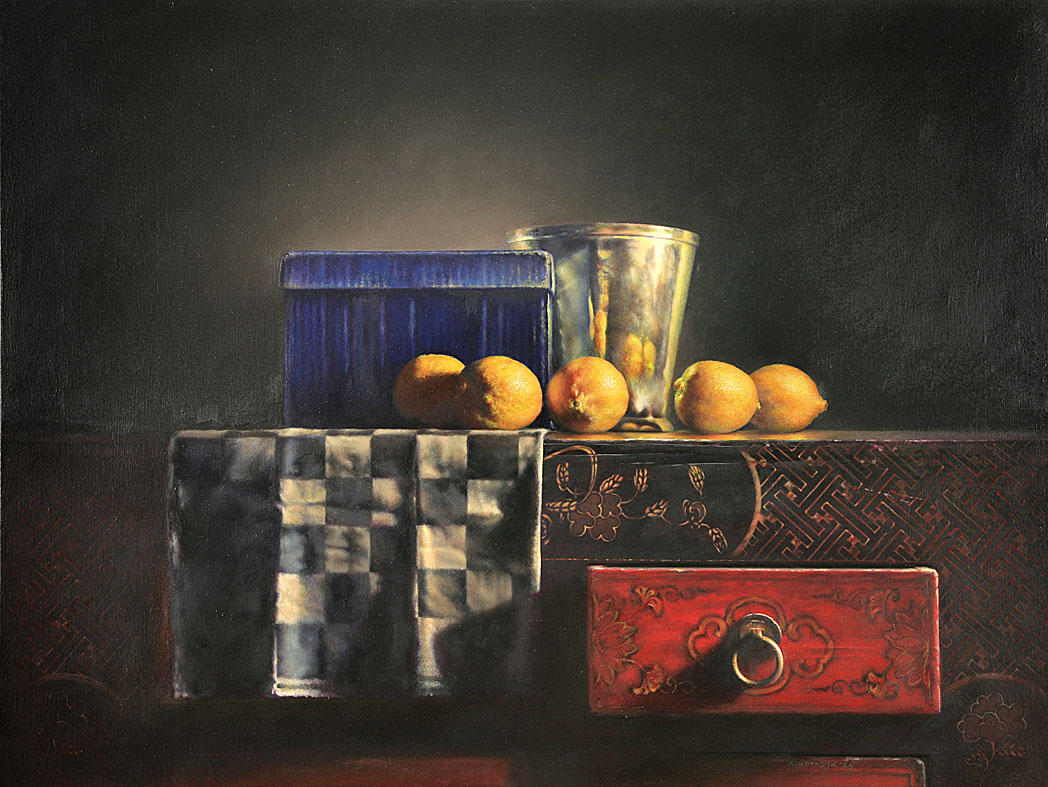
In 1982 trad Bert Kinderdijk toe tot de gelederen van de galerie. Zijn bereik betrof niet alleen liefhebbers in eigen land. Zijn schilderijen gingen ook mee naar onder andere New York, Athene en Basel, en natuurlijk de Tefaf. Niettemin, of wellicht juist daardoor, nam hij aan het eind van de eeuw het besluit zich te bevrijden van de druk die dat genereerde en ging op eigen houtje aan de weg timmeren. Jammer voor de galerie, maar afdwingen staat hier niet op het menu. Vijfentwintig jaar later, het is inmiddels 2022, stapte Kinderdijk op een zonnige zondag Museum Slager in ‘s-Hertogenbosch binnen, waar ik de eer had met een brede selectie uit de collectie van de galerie de wanden te mogen vullen, en toonde hij een prachtig schilderij op zijn telefoon. Met dat gebaar was de samenwerking hernieuwd. We zijn nu vier jaar en veertien schilderijen verder, wat maar tot één ding kan leiden: een tentoonstelling. Een van zijn eerste schilderijen is “Doos van Pandora”. Hoewel stillevens zich lang niet altijd naar een verhaal laten of willen vertalen, waarover verder meer, weet Kinderdijk het zo te plooien dat de gevoelswaarde van zijn stillevens intact blijft, zelfs als je de aanknopingspunten, die dikwijls sluimeren in de titel, kent. Hoewel het origineel, of beter gezegd de naam Pandora, verknoopt is met die zowel romantische als gruwelijke thematiek waar de Griekse mythologie zo in uitblinkt, met woedende goden, die er niet voor terugdeinzen hun macht met wraak te tooien, met illegale liefdesgeschiedenissen, en natuurlijk met eigenwijze helden, die zegevieren of botvangen, al naargelang het empathisch vermogen van de goden, heb ik de indruk dat in de wandeling de gemiddelde aanroeper van de naam Pandora vooral refereert aan het feit dat er verrassingen volgen op het openen van de doos, en verrassing is op de eerste plaats toch een positief woord. Om nou te voorkomen dat die goden mij hiervoor treffen met hun toorn breng ik als vleierij in dat ik het zo leuk vind dat die goden behalve boos worden ook vreemd kunnen gaan, want dat is voor de gemiddelde god toch tamelijk uniek. Je zou kunnen stellen dat de beleving van een stilleven met het verstrijken van de tijd meebeweegt met de waarden van het heden. U kunt dat afmeten aan de voorzichtigheid waarmee kunsthistorici het oorspronkelijk narratief van een eeuwenoud stilleven proberen te verwoorden, in die zin dat het om vermoedens gaat, zelfs als er teksten beschikbaar zijn, die dienaangaande informatie verstrekken. Ik heb een Vlaamse collega eens uitgelegd dat het helemaal niet onmogelijk is dat een schilder, levend in de zeventiende eeuw, ‘s morgens wakker wordt, een appel op een plank ziet liggen en denkt “wat een mooie appel, die ga ik schilderen”, terwijl de kunsthistoricus hoog opgeeft van de symbolische betekenis van de vervolgens geschilderde appel, waar hij vier eeuwen later naar kijkt en waaraan hij een van symboliek doordrenkte alinea in een kunstboek besteedt. Hij, de collega, keek me aan alsof hij namens mij zijn mond ging spoelen. Ik heb respect voor de eerbied van de collega, maar de vermenselijking van een schilder uit die tijd heeft toch ook iets aantrekkelijks, die zat echt niet de hele dag symbolen te tellen. Wat overigens niet wegneemt dat op het dwangmatige af in een boek bij die appel een tekstje moet verschijnen dat, eenmaal gedrukt, de mare van de symboliek een halve eeuwigheidswaarde geeft, en zo elk hypothetisch narratief legitiem maakt, want anders blijven alle pagina's leeg. Ik heb er dus begrip voor. Adembenemend is een woord dat ik op het irritante af koppel aan schoonheid. Dat heeft alles te maken met het verlangen naar die ervaring, want die momenten zijn dun gezaaid, en bovendien, als topspin mindbonus, onderhevig aan het verstrijken van de tijd. Echte diepgevoelde schoonheid kan aan een object worden gekoppeld, maar is in wezen een abstracte aangelegenheid, want kan zijn oorsprong net zo goed ontlenen aan ideeën en gedachten. Ik las overigens onlangs met enige verbazing een artikel waarin pracht en praal wordt verward met schoonheid. Kijk naar de schilderijen van Bert Kinderdijk en merk op dat het begrip mooi niet slaat op schoonheid van de individuele voorwerpen. Het is enerzijds een spel van associaties, dat een wisselwerking van indrukken en gedachten op gang brengt, anderzijds een visueel spektakel van balanceren van vormen en kleuren, en dat alles samengebonden door lichtspel, ruimte en diepte, Ik durf geen poging te wagen in woorden uit te drukken hoe en waar in zo'n stilleven die ervaring van adembenemende schoonheid zich manifesteert, want dat is voor iedereen anders. Maar als slotaccoord van bovenstaande ontboezeming durf ik het toch aan een hint te geven door een treffend detail te beschrijven in het schilderij "Met Kunst- en Vliegwerk", in het besef dat dit geen uitleg is. Mijn blik pendelt op en neer tussen de de oudrose bol op de roestige console en het eitje, dat hangt aan een net zo roestige tot zwijgen gebrachte veer, die, als alles nog intact was en zou bewegen conform het machinale lot, het eitje onmiddellijk zou verbrijzelen, maar nu hangt het daar onaangedaan, wat afwezig van de schijnbaar voortaan eeuwige dominantie te genieten, niet wetend dat mijn oog instantaan weer naar boven zwaait, naar die onbenoemde planeet, althans de globe daarvan, of hoe dat ook heet in dat naburig sterrenstelsel. Waar, als het leven daar een kans heeft gekregen, ooit de strijd om het voortbestaan is losgebarsten, althans, zo noemen wij dat hier op aarde, maar voor het universum is het een kwestie van reageren op wat er voorbij komt. Koen Nieuwendijk TOP The Road to Breathtaking Beauty It was in 1982 that Bert Kinderdijk joined the gallery’s roster, reaching his aficionados not only on native soil but seeing his paintings travel far and wide including to New York, Athens and Basle, in addition to which his work commanded rightful pride of place at TEFAF, the annual Maastricht-based global art community exhibition. Acclamation notwithstanding (or was it the rave reviews that prompted his decision?), the artist at the time the second millennium was drawing to a close had come to the conclusion that he needed to break free from the pressures of fame and go it alone – much to the gallery’s loss, but coercion is not a dish that has ever been on the menu where I’m concerned. Fast forward to 2022, when on a sunlit Sunday Bert Kinderdijk dropped by the Slager Museum in Bois-le-Duc, where I had most graciously been invited to deck the halls (not to mention the walls) with a broad selection of works by the gallery’s artists, to show me a picture on his ‘phone of an exquisite painting. It was this gesture which caused our collaboration to be reignited. Fast forward by another four years and fourteen paintings and a solo exhibition was, and is, the only way forward. “Pandora’s Box” is one of Bert Kinderdijk’s earliest paintings. Although it’s not a law of nature for still lifes to accommodate or promote their own translation into a narrative (I’m circling back to this later), the artist knows how to arrange his creations in such a way as to preserve the emotional charge of his still lifes even if the clues themselves – implied as they often are by the titles – are a known quantity. Although the original version, or rather, Pandora as a name is intertwined with the romantic yet gruesome themes Greek mythology deploys with such superior deftness, as witnessed by raging deities who stop at nothing when it comes to lacing their authority with pure vengeance, by forbidden affairs of the heart and – inevitably – by wayward heroes who either prevail or miss out depending on the empathic capacity of the gods, I cannot help thinking that the average person to invoke the name Pandora will predominantly refer to the fact that opening the box will cause particular surprises to be released, and isn’t “surprise” primarily supposed to hint at something to look forward to? To which I hasten to add, as my way of flannelling the deities in question into refraining from unleashing their wrath upon me, that I’ve always been particularly charmed by the fact that said deities are as accustomed to throwing tantrums as they are to committing infidelity – which is pretty unique for the average supreme being, wouldn’t you agree? One could argue that the experience of a still life keeps pace with the norms and values of the now as time moves on. This can be measured by the caution observed by art historians when putting the original narrative of a centuries old still life into words, in that it’s all about presumptions even where documents are available that provide the requisite information. I once explained to a Flemish colleague of mine that it’s not at all far-fetched to think of a seventeenth century painter waking up one morning, spotting an apple sitting on a shelf and thinking to himself, “that apple is so lovely, I think I’ll use it in a painting”, whereas the art historian four centuries later in an art book waxes lyrical, in terms steeped in symbolism, about the emblematic significance of the apple in the resultant painting. The expression on the face of my colleague from Flanders suggested he was about to wash his mouth, possibly with soap, on my behalf. I respect his deferential attitude, but isn’t there something to be said for the humanisation of the artist as someone who after all would have had better things to do than spend the entire day counting symbols ? None of which by the way alters the fact that a near- compulsive urge necessitates the illustration showing the apple being accompanied by a few lines of text in a book that, once printed, will for all time glaze the lore of symbolism with an element of semi-eternal value, in validation of each and every hypothetical narrative. I appreciate that, given that all the book’s pages would otherwise be left completely blank. “Breathtaking” is an adjective I tend to use in tandem – to the point of annoyance, I‘m sure – with “beauty”. This is everything to do with my underlying desire to undergo the actual experience, in moments that are few and far between as well (and here we have your topspin mind bonus) as being susceptible to the lapsing of time. Although genuine beauty that is profoundly felt can be linked to an object, it essentially is something abstract whose origin could just as easily be linked to notions and thoughts. I was somewhat taken aback when I realised that an article I was reading confused pomp and circumstance with beauty. Just look at Bert Kinderdijk’s paintings and you will see that it is nothing to do with the beauty of the individual objects in which the appreciation is anchored. On the one hand it is an associative stratagem that sets off a process of interaction between impressions and reflections, while on the other it is a visual extravaganza of shapes and colours that balance one another out, all of this bound together by play of light, by space and by depth. Suffice it to say at this point that I wouldn’t dare put into words how and where the experience of breathtaking beauty manifests itself in such a still life, given that it’s all in the eye, and the mind, of the beholder. And yet I feel brave enough by way of a final flourish to provide you with a clue, by describing a striking detail in the painting whose Dutch title, “Met kunst- en vliegwerk”, is best translated as “By Hook or by Crook”. (The Dutch expression that has been used as the painting’s title has its 17h century origin in the world of theatrics, with all kinds of mechanical devices being used to imitate natural phenomena such as thunderstorms, in conjunction with rope-and-pulley systems enabling actors and props to take flight.) My gaze shifts back and forth between the dusty pink sphere perched on top of the rusty console and the egg suspended from an equally rusty, now silenced spring, which if the whole structure were still up and running in accordance with its mechanically dictated purpose would instantly shatter the egg, but which instead has left said egg suspended unharmed, to enjoy in a somewhat remote manner its seemingly permanent dominance, blissfully unaware that I can’t stop my gaze instantly shifting upwards, back to the nameless planet or rather, to the globe thereof or whatever its correct name may be in the neighbouring galaxy, as the place where the struggle for life once erupted in so far as life was given a chance, or that’s what we earthlings call it even though the universe deals with it as a matter of responding to anything that passes by. This leaves no room for experiencing breathtaking beauty, for where the universe sticks to fixed rules resulting in it being predictable, the human mind by contrast affords itself the luxury of associative filibustering of thoughts unfettered by logic - which is a most precious asset. Koen Nieuwendijk (translation: Tekstwerk, Amsterdam) TOP |

|
To enlarge click on image "Kunst- en Vliegwerk" 2014-2026 olieverf/doek op paneel, 51,2 x 39,2 cm € 6.500 "Voor Niet Gemaakte Reizen 2026 olieverf/paneel, 60 x 50 cm (verkocht-sold) "Citron Pressé" 2024 olieverf/doek, 60 x 80 cm (verkocht - sold) "Herfstblik 2026 olieverf/paneel, 23 x 53 cm € 3.800 "De Tas van Elsschot" 2023 olieverf/doek, 65 x 80 cm € 9.600 "Lijn 14" 2023 olieverf/doek, 60 x 80 cm € 9.000 "Op Gespannen Voet met het Verleden" 2023 olieverf/paneel, 60 x 50 cm € 8.500 "Een Mooie Dag" 2023 olieverf/paneel, 40 x 30 cm € 3.800 "Lotgevallen van Moeder Aarde" - 2022 olieverf/doek, 50 x 40 cm € 8.200 "Pandora" - 2021 olieverf/doek op paneel, 49 x 60 cm € 7.800 "Nachtkoerier" - 2022 olieverf/doek, 40 x 50 cm (verkocht-sold) "Op de Valreep" - 2025 olieverf/doek, 50 x 40 cm € 6.500 "Hoorspel XK120" 2024 olieverf/doek, 30 x 40 cm € 3.800 "Bij Nadere Beschouwing" 2025 olieverf/doek op paneel, 87,5 x 79 cm € 11.000 |
TOP